Guides
Laundromat plan: the questions that matter
A laundromat plan starts with the ordinary wash cycle, asking what a load costs, who runs the machines, and what the neighborhood laundromat pays.
What to take away
- A plan carries five blocksstartup budget, cost per cycle, staffing schedule, local demand test, and break-even.
- Cost one 20 lb wash-dry-fold order from utility rates, chemicals, card fees and labor minutes, then divide committed monthly cost by contribution per cycle.
- A twelve-washer store that leans on self-service commonly needs roughly 1,800 to 2,000 cycles a month to clear committed cost, a typical range to replace with your own numbers.
- Open with 60 to 90 attendant and processor hours a week, at $13 to $18 an hour for attendants in the United States.
- Test demand with a pilot route, letters of intent and a competitor count before you sign a lease.
Five blocks every plan carries
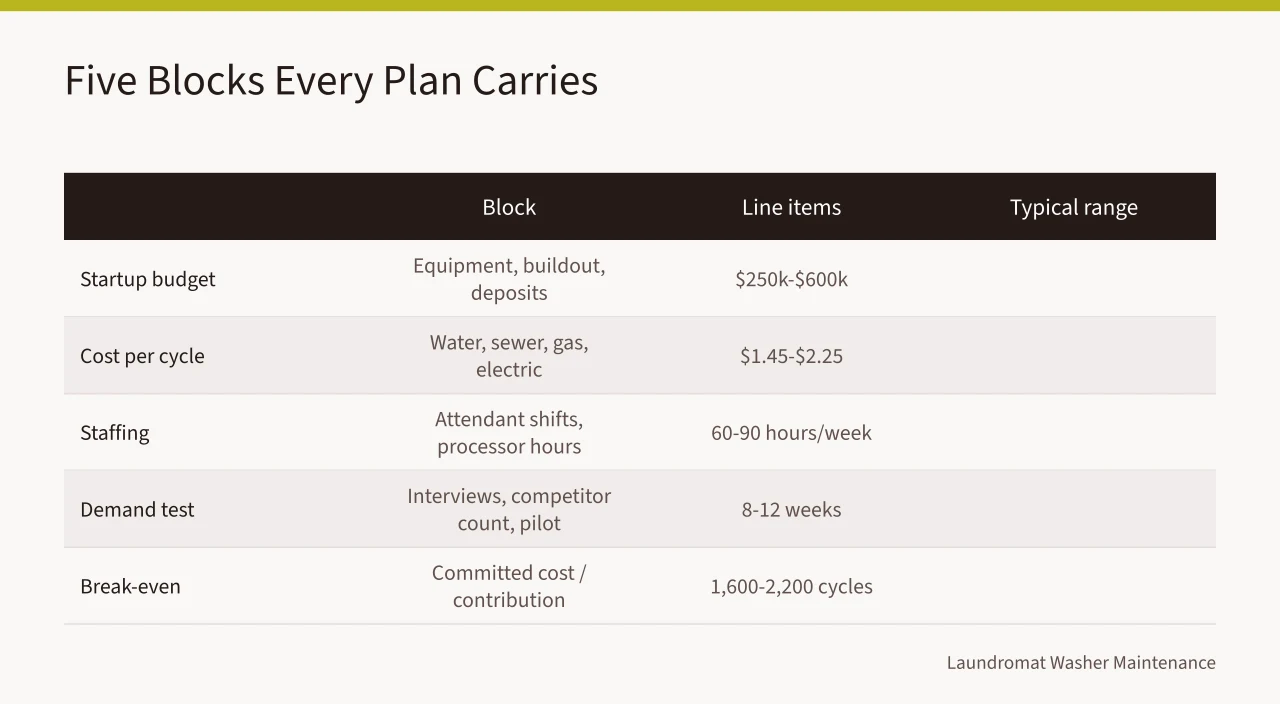
Each block answers a question a lender or a landlord will ask.
| Block | Line items | Typical range to check |
|---|---|---|
| Startup budget | Equipment, buildout, deposits, permits, working capital, contingency | $250,000 to $600,000 for 12 to 20 washers |
| Cost per cycle | Water, sewer, gas, electric, chemicals, card fee | $1.45 to $2.25 per 20 lb order |
| Staffing | Attendant shifts, processor hours, maintenance contract | 60 to 90 hours a week |
| Demand test | Interviews, competitor count, pilot offer, letters of intent | 8 to 12 weeks |
| Break-even | Committed monthly cost divided by contribution per cycle | 1,600 to 2,200 cycles a month |
Settle the store format first, since machine counts drive the equipment line; what a store cannot open without covers the choices.
An equipment quote is one line; deposits, working capital and contingency sit beside it, and utility deposits commonly run one to three months of the service bill.
The cost of one wash-dry-fold cycle
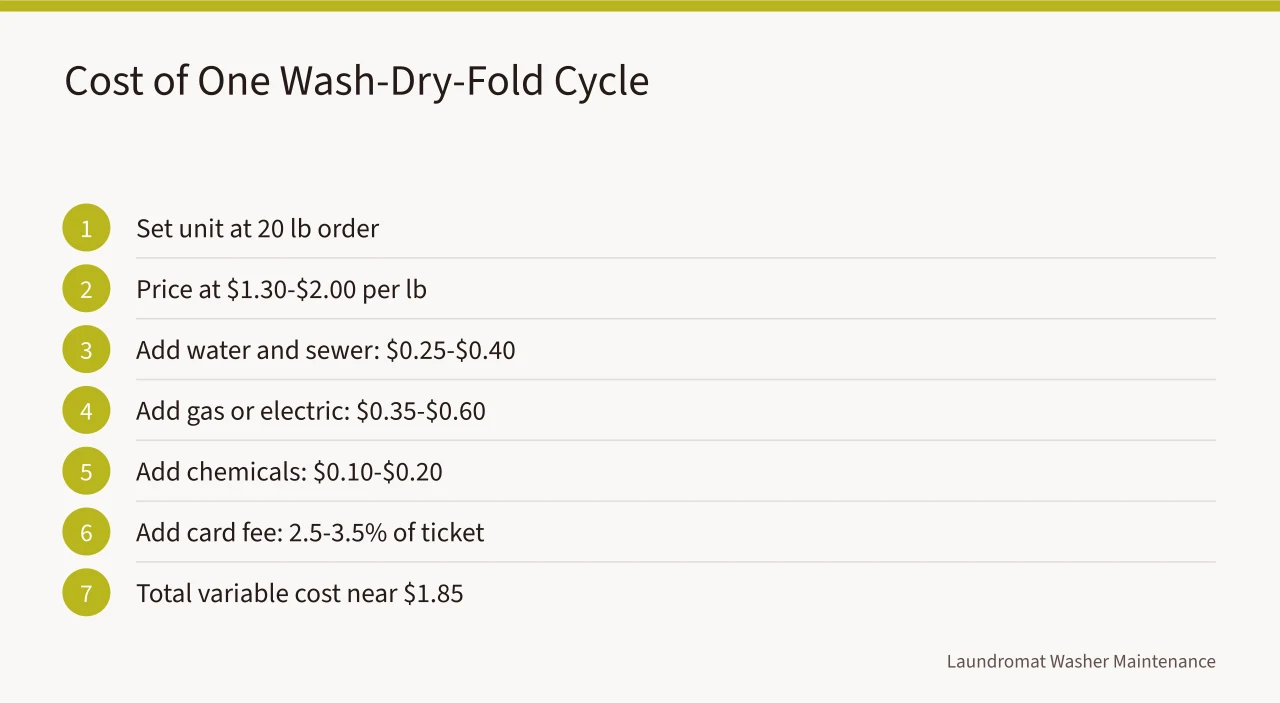
Work from your own utility bill. These steps give the shape and a typical range per step.
Cost of one wash-dry-fold cycle
- Set the unit at a 20 lb order.
- Price it at the neighborhood rate, commonly $1.30 to $2.00 per lb, so $26 to $40 a ticket.
- Add water and sewer. A 20 lb order uses about 30 gallons, so $0.25 to $0.40 at $8 to $12 per 1,000 gallons.
- Add gas or electric for washing and drying, roughly $0.35 to $0.60.
- Add chemicals, about $0.10 to $0.20.
- Add the card and payment fee, 2.5 to 3.5 percent of the ticket.
- Leave scheduled hours out of this step and put them in committed monthly cost.
Total variable cost lands near $1.85 for the order. The gap to the ticket is contribution.
Set the order price from your own steps rather than a competitor's sign; working out prices from the bottom up runs the same arithmetic per pound.
Example: break-even on a twelve-washer store
Committed monthly cost for a store with two counter shifts and a part-time processor:
Break-even on a twelve-washer store
- Rent and common area charges
- $4,800
- Equipment debt
- $2,200
- Insurance
- $400
- Software and card hardware
- $180
- Fixed utilities and hot water
- $900
- Maintenance contract
- $250
- Wages, 70 hours a week at $15 plus payroll taxes
- $5,100
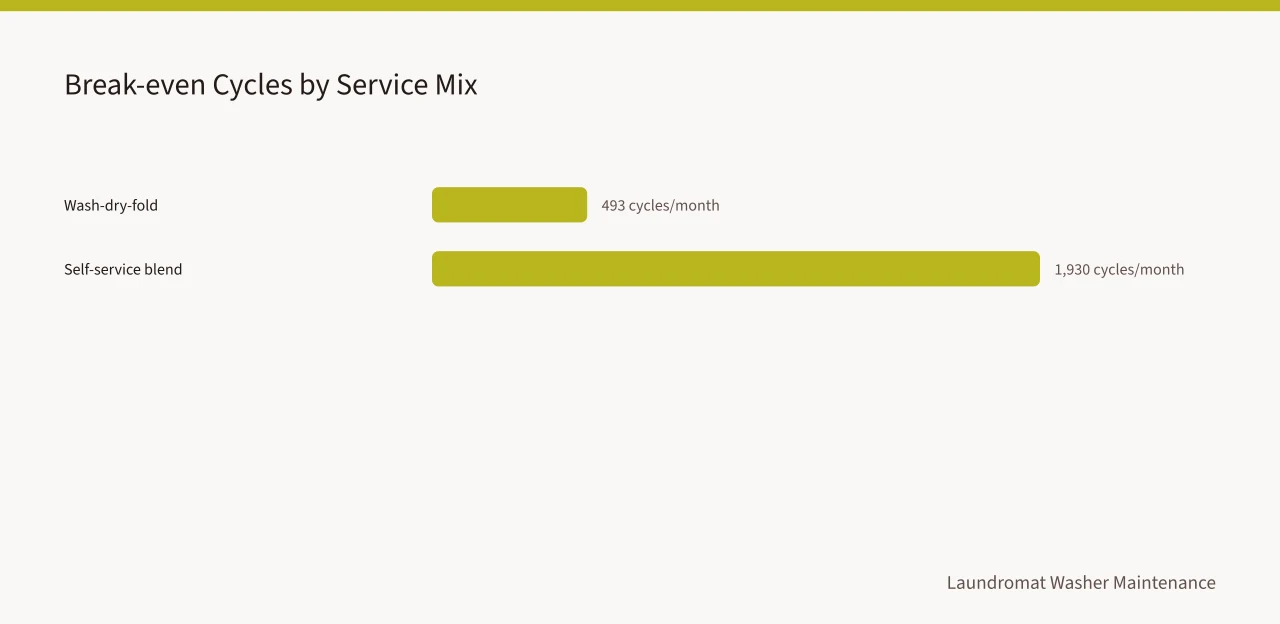
That totals about $13,800 a month. At $28 contribution per wash-dry-fold order, break-even is 493 orders a month, about 16 a day.
Mix changes the answer. At a blended $9 per self-service cycle and $1.85 variable cost, contribution is $7.15, and break-even rises to about 1,930 cycles a month, roughly 64 a day.
Staffing the first service mix
Cover the counter before you add machines.
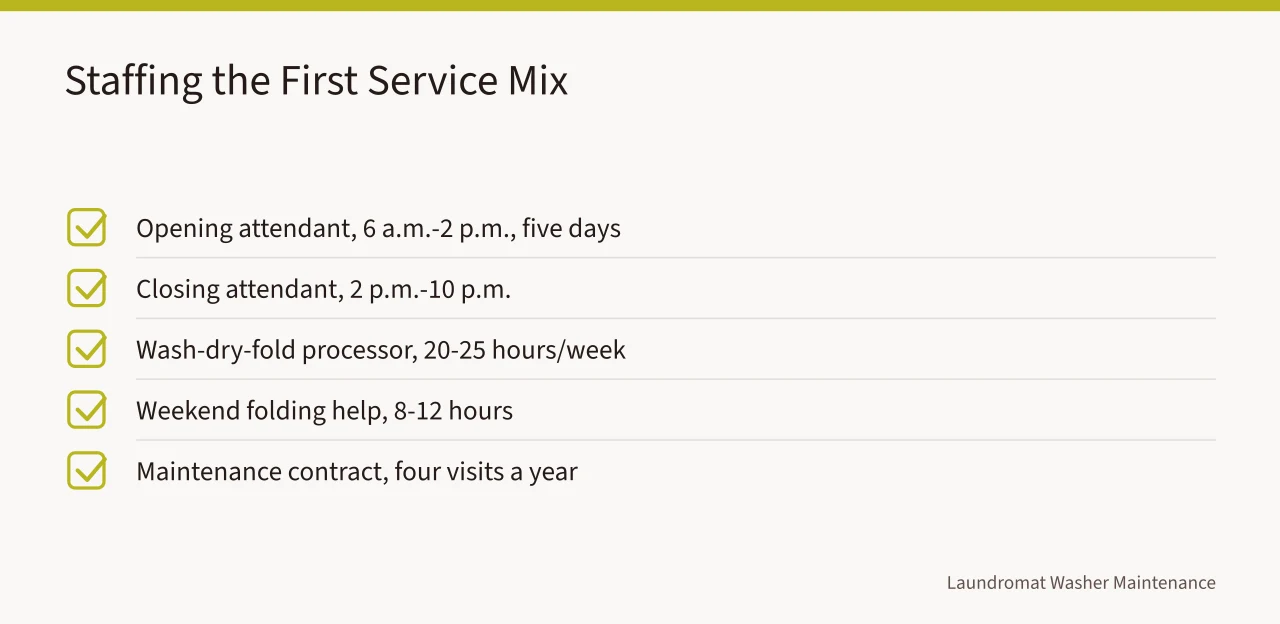
Attendants commonly earn $13 to $18 an hour in the United States, and payroll taxes add roughly 10 to 12 percent. Settle coverage before you post the job; how a laundromat hires people it can count on covers the trial shift and the scorecard.
Demand testing before the lease
- Interview apartment managers, hotel housekeeping leads and small restaurants within two miles.
- Count competitors within 1.5 miles and record machine counts, posted prices and hours.
- Pull census tract data on renter share and households without a washer and dryer.
- Run an 8 to 12 week pilota pickup route, or two machines held for wash-dry-fold orders.
- Collect letters of intent from two or three referral partners.
Count repeat orders, not population. The U.S. Bureau of Labor Statistics industry page for laundry services gives establishment and employment figures for the sector; treat them as background, not local demand.
Permits, licenses and lease terms
- A general business license and a certificate of occupancy from the city or county.
- Plumbing and electrical permits for new water, drain and power runs.
- Gas fitting by a licensed contractor under NFPA 54 and NFPA 58.
- Sewer discharge approval where the local authority limits wash water; Ontario Regulation 210/17 sets limits in that province.
- Written lockout/tagout procedures for machine maintenance, as OSHA 1910.147 requires.
The SBA business guide covers startup costs, permits and hiring. On the lease, watch the personal guarantee, common area charges, exclusivity, minimum opening hours and who pays for a lint blockage. A working brief on laundromat lease costs lists the charges to expect.
The IRS guide to starting a business covers entity choice, the tax ID and record keeping from day one.