Guides
Capital for a laundromat: what it takes and where it comes from
A laundromat's capital goes into washers, dryers, utilities, and build-out. Here are the real funding sources, from SBA loans to equipment leases.
What to take away
- Capital for a laundromat splits into three bucketsthe build-out, the machine room, and the working cash that carries the first slow months.
- The machine room is the largest line and the one lenders understand best. Washers and dryers are serial-numbered collateral.
- SBA 7(a) and 504 loans, equipment leases, seller financing, and home equity are the four sources most owners actually use.
- Water and sewer capacity, gas service, electrical service, and ventilation often cost more than the machines.
- Every figure below is a variable you fill with local quotes, not a benchmark to copy.
This is general laundromat business information only. It is not advice on:
- utilities
- plumbing
- electrical
- gas
- wastewater
- equipment repair
- licensing
- employment
- tax
- insurance
- leases
- law
Your building, machines, jurisdiction, and local code decide what applies, so rely on qualified technical and local guidance.
Where the money goes
A laundromat is a real estate business wearing a laundry apron. The capital question is not "how much does a laundromat cost" but "how much does this building cost to turn into a laundromat."
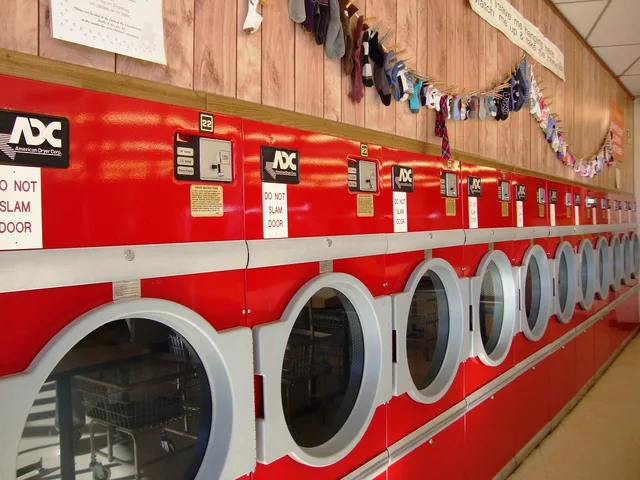
Start with the machine room. A commercial front-load washer runs from roughly $4,000 to $12,000 new, and capacity sets the price. A 20-pound unit sits near the bottom of that range; a 40-pound unit sits near the top. A matching dryer runs from $3,000 to $9,000.
Speed Queen, Huebsch, and UniMac come from Alliance Laundry Systems. Wascomat and Electrolux come from Laundrylux, and Continental Girbau sells through distributors. A 2,000-square-foot store with 20 washers and 20 dryers typically carries $150,000 to $400,000 in machines. Add two or three spares: a down machine earns nothing.
Then the building. Water and sewer capacity, gas service for dryers, electrical service for the motors, and machine-room ventilation are the four items that blow budgets. A building that has never held laundry equipment may need a service upgrade before a single washer lands.
Typical tabs in most markets: a 200-to-400-amp service upgrade runs $3,000 to $10,000, and makeup air plus exhaust for a bank of dryers runs $8,000 to $30,000. Flooring adds $5 to $12 per square foot, and exterior signage adds $2,000 to $15,000.
Finally, working capital. Card systems settle on a delay, utilities bill monthly, and the first winter is slow. Hold enough cash to cover rent, utilities, and one service call a month for several months before you open.
Three to six months is the usual target. A store with $6,000 in monthly fixed costs needs $18,000 to $36,000 in reserve.
The funding sources, by name
SBA 7(a) and 504 loans
The 7(a) program is the workhorse for small business acquisition and startup. The SBA partially guarantees the loan, but a participating bank still underwrites you and sets the rate. Loans top out at $5 million.
Rates are negotiated and capped at prime plus 2.25% on loans above $350,000 with a maturity of seven years or more. Smaller or shorter loans are capped at prime plus 2.75%. Repayment runs up to 10 years for equipment and working capital, and up to 25 years for real estate.
SBA guarantee fees scale with loan size and have been waived in recent fiscal years for smaller loans. SBA Lender Match, a free tool on sba.gov, sends your profile to SBA-approved lenders, who usually make contact within two business days.
Live Oak Bank in Wilmington, North Carolina, ranks among the largest 7(a) lenders by dollar volume and publishes a lending page for vended laundries.
The 504 program pairs a bank loan with a certified development company loan for fixed assets like real estate and heavy equipment. The split is typically 50% bank, 40% CDC, and 10% borrower equity. The CDC portion carries a fixed rate for 20 years, which suits real estate better than equipment.
Both require a business plan, projections, and personal financials, and you sign a personal guarantee. On a 7(a) loan above $350,000, SBA rules also require a lien on your personal residence. Neither program is fast. Start the conversation before you sign a lease.
Equipment leases and financing
Washer and dryer distributors often finance their own machines. Alliance Laundry Systems Financial Services backs Speed Queen, Huebsch, and UniMac equipment, and Laundrylux Financial Services backs Wascomat and Electrolux. Third-party lessors such as TimePayment write laundry leases as well.
An equipment lease keeps the machines off your balance sheet and preserves bank credit for the building. The tradeoff is a higher effective rate and a lien on the equipment until it is paid.
Leases are quoted as a factor, a percentage of equipment cost paid each month. Typical factors run about 0.025 to 0.035 over terms of three to seven years. The same factor costs more in interest over a longer term.
Seller financing
When you buy an existing laundromat, the seller frequently carries a note for part of the price. This is common because the seller knows the cash flow and wants the deal to close. It also means the seller has a reason to help you succeed during the transition.
Sellers commonly carry 10% to 30% of the price on a three-to-seven-year note, with the bank holding first position on the assets. Vended laundries listed on BizBuySell often show asking prices set at two to four times annual earnings.
Home equity and personal capital
Many owner-operators use a home equity line for the build-out. It is fast and cheap relative to unsecured debt, but it puts your house behind the business. Treat it as a deliberate choice, not a default.
HELOC rates typically run a point or two above prime, so budget 7% to 10% as of 2026. Community development financial institutions such as Accion Opportunity Fund lend $5,000 to $250,000 to smaller operators.
What lenders want to see
Lenders underwrite laundromats on three numbers: utility cost per machine, revenue per turn, and debt service coverage. They want debt service coverage of at least 1.20, meaning net operating income covers the loan payment by 20%. They want to see that the machines can pay for themselves.
Bring utility bills from the building's history if you can get them. Bring a service contract or a written maintenance plan. Bring the payment system's fee schedule, because card processing is a real cost line.
Card and mobile payment systems from Card Concepts, Setomatic Systems, and PayRange take 3% to 6% of each transaction, plus $1,500 to $8,000 in hardware for a small store.
The U.S. Bureau of Labor Statistics: Drycleaning and Laundry Services: Industry at a Glance page gives establishment, employment, and earnings context for the sector. It is a starting frame, not a substitute for local utility and demand analysis.
The U.S. Small Business Administration: SBA Business Guide lays out planning, launch, permits, insurance, and finance in one place. The Internal Revenue Service: Starting a business page covers structure, tax IDs, and recordkeeping. Both are checkable sources, not advice.
The arithmetic you run yourself
Write these as variables and fill them with local quotes:
- Build-out= service upgrade + plumbing + gas + ventilation, plus flooring and signage.
- Machine room= (washers × unit cost) + (dryers × unit cost) + spares + payment system.
- Working capital= months of rent + utilities + insurance + one service call per month.
- Break-even turns= (fixed monthly costs) ÷ (revenue per turn − variable cost per turn).
Say fixed monthly costs run $12,000, each turn brings in $6.50, and water, gas, and electric cost $2 per turn. Break-even is $12,000 divided by $4.50: about 2,700 turns a month, or 90 a day.
A 20-washer room turning 12 loads a day each can process 240 turns a day.
If break-even turns exceed what the room can physically process in a week, the deal does not work at any funding level.
One illustration
Worked example
An owner buys a 2,000-square-foot storefront with eight washers and eight dryers already installed. The building has gas service but no makeup air for the dryers, so ventilation is the first capital item.
The owner uses an SBA 7(a) loan for the ventilation and build-out, leases four replacement washers from the distributor, and keeps three months of rent in reserve. Ventilation lands near $15,000, four leased washers add about $900 a month, and rent at $4,000 a month makes the reserve $12,000.
The laundromat startup and market guide walks through the market side of that decision.
Winter bedding loads fill the calendar past what the machines can process. The owner either adds capacity or turns work away. Getting the business licensing paperwork current in week one is what keeps the doors open while the loan is still being serviced.
Common questions
How much capital does a laundromat need?
There is no single number. It depends on whether you buy an existing store or build out a shell, how many machines the room holds, and what the utilities need.
Typical ranges in most markets: $150,000 to $600,000 to buy an operating vended laundry, and $250,000 to $1,000,000 to build one out in a shell, before working capital. Build your own total from local quotes for build-out, machines, and working capital.
Which funding source should I use first?
Most owners stack sources: an SBA loan for the build-out, an equipment lease for the machines, and personal cash for the gap. That order puts the real estate on a long amortization and the machines on a short one.
Talk to a lender and a CPA before you sign anything, because the order affects your tax treatment and your collateral.
Do I need a business plan to get a loan?
Yes, for any bank-backed loan. Lenders want projections, utility history, a maintenance plan, and the payment system's fee schedule. The SBA guide linked above lists what a plan should cover. A 7(a) package also needs three years of personal tax returns and a personal financial statement.
Can I finance used machines?
Often, yes, through the seller or a specialty lender. Used machines cost less but carry more downtime risk, so budget for a service contract and spare parts. Expect used equipment at 40% to 60% of new price, depending on age and hours. Have a licensed technician inspect any used machine before you buy it.