Guides
Where laundromat demand is heading in 2027
Laundromat demand in 2027 turns on renter households, aging machines and utility costs, not on marketing. Here is what owners can measure now.
What to take away
- Laundromat demand in 2027 tracks renter households, housing age and utility rates. New apartment construction alone does not explain it, and marketing spend barely moves it.
- The BLS Drycleaning and Laundry Services group (NAICS 8123) counts laundromat establishments and employment. Pull it before you sign a lease.
- Water, gas and sewer rates rise faster than vend prices. A 2027 pro forma built on 2024 utility numbers is already wrong.
- Washers past their rebuild window cost more in downtime than in parts.
- Card and app payment, plus pickup and delivery, decide who keeps the customer. Machine count does not.
This article covers laundromat operations in general, not the rules that apply to your building. Your state and city set utility, wastewater, gas and electrical requirements. They also set equipment and accessibility rules. Confirm both with the permitting authority and a licensed technician before you commit money.
What actually drives laundromat demand
Laundromat traffic follows renters who lack in-unit hookups. The Census Bureau's American Community Survey counts those households down to the neighborhood, and the number moves slowly. The category rarely swings hard from one year to the next.
Three things change it faster than demographics do.
Housing age. Washers in older rental stock break more often and get replaced less often. The Census Bureau's American Housing Survey tracks the age of that stock. Buildings past their third decade of plumbing push tenants to the corner laundromat even when a hookup exists.
Utility cost pass-through. When a landlord raises rent to cover water and gas, tenants who once washed at home start pricing a wash-and-fold run instead.
The Energy Information Administration's Short-Term Energy Outlook projects commercial power and gas prices. The American Water Works Association's biennial rate survey has shown water rates climbing in the mid single digits a year in many systems.
Labor availability. Attended stores and pickup-and-delivery routes both need staff. Where hiring is tight, unattended 24-hour formats gain ground. The BLS Job Openings and Labor Turnover Survey tracks how many service-sector jobs sit unfilled.
None of this is a forecast you can buy. It is a set of local readings you take yourself.
Where to get laundromat numbers you can defend
Two public sources carry real weight, and both are free.
The U.S. Bureau of Labor Statistics: Drycleaning and Laundry Services page publishes establishment counts, employment, occupation mix, earnings and productivity for NAICS 8123. It is the closest thing to an official laundromat census. Use it to check any broker's claim about market size.
The U.S. Small Business Administration: SBA Business Guide lays out planning, launch, management and growth steps. It covers these topics:
Where to get laundromat numbers
- market research
- startup costs
- permits
- insurance
- finance
- hiring
It is a checklist, not a market study.
For renter counts, the Census Bureau's American Community Survey and Housing Vacancy Survey are free. Multifamily research firms CoStar and Yardi Matrix track apartment completions, which shape the renter base about two years out.
For the ground truth, count cars in the lot at 7 a.m. Sunday and 9 p.m. Tuesday. Two visits tell you more about a site than a demographic ring does.
Five trends shaping 2027
Renter household growth slows in 2027 as the apartment delivery wave that peaked in 2024 and 2025 fades. Utility costs keep climbing faster than vend prices. Those two forces set the floor and the ceiling on store revenue.
1. Card and app payment displacing coin. Coin handling costs labor and invites theft. PayRange, FasCard from Alliance Laundry Systems and SpyderWash from Setomatic Systems replace coin drops with tap or app payment. Readers typically run $150 to $400 per machine, and processing takes roughly 2 to 4 percent of each transaction.
Stores that switched report cleaner books and better customer data. The trade-off is those fees, which land in your break-even math.
2. Pickup and delivery as a second business. Rinse, Poplin and Hampr sell wash-and-fold to households in large metros, typically at $1.50 to $2.50 a pound or a flat bag price. Running your own route needs a vehicle, a driver and a sorting area. It also locks in customers who would otherwise drift to a competitor closer to home.
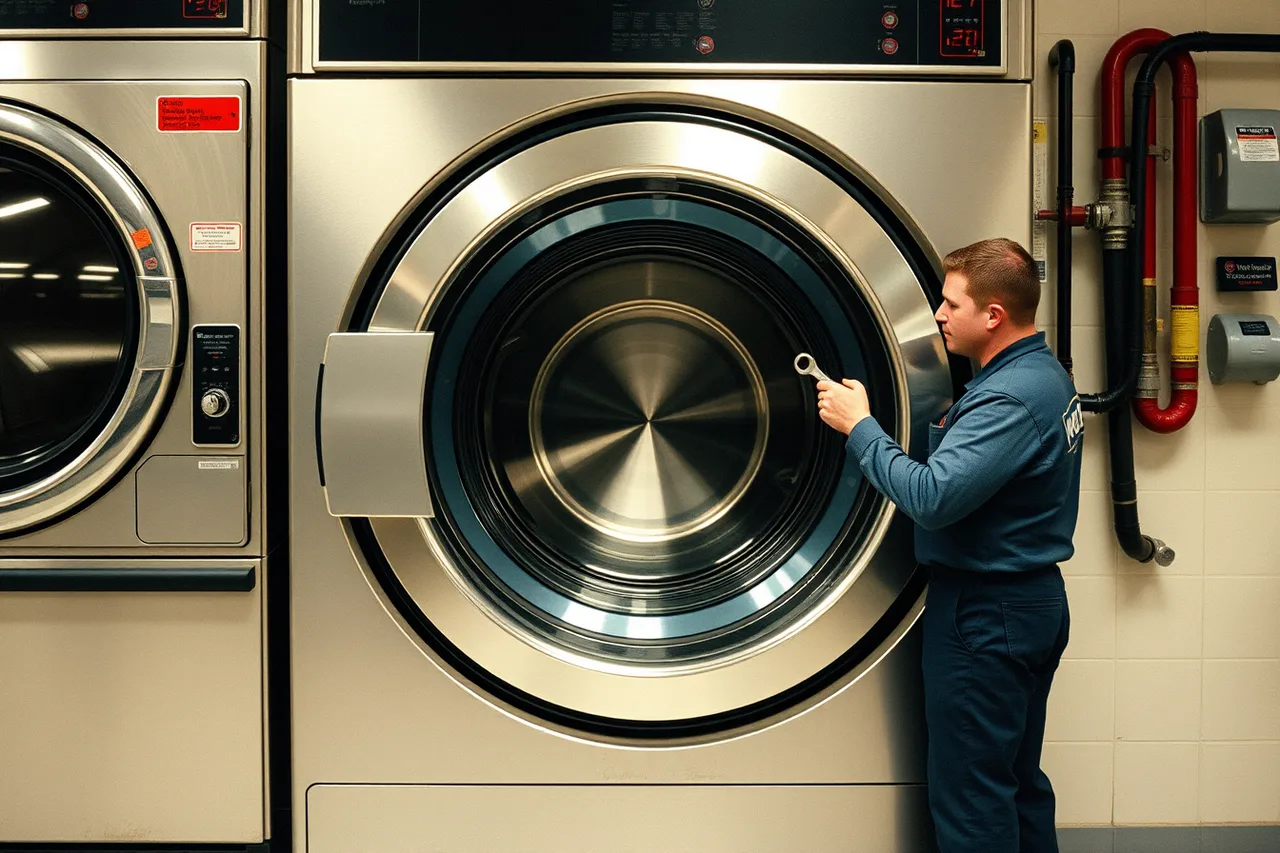
3. Larger-capacity washers. Speed Queen, UniMac and Huebsch come from Alliance Laundry Systems in Ripon, Wisconsin. Dexter Laundry builds in Fairfield, Iowa, and Pellerin Milnor in Kenner, Louisiana. In most markets a new 40 to 60 pound front loader runs $9,000 to $16,000 installed.
Bigger drums cut cycle count per customer and raise revenue per square foot. They also demand more hot water and gas capacity than many older buildings supply.
4. Water reuse and high-efficiency machines. The Consortium for Energy Efficiency rates commercial washers on water and energy use, and utilities tie rebates to those tiers. Typical rebates run $100 to $500 per qualifying washer, and Austin Water and SoCalGas publish terms online.
Reuse systems that recirculate rinse water, sold by suppliers such as AquaRecycle, cut consumption further and usually need a discharge permit. Check the program before you order, not after.
5. Unattended 24-hour formats. Lower labor cost, higher risk of vandalism and machine abuse. Card-only payment through PayRange, FasCard or SpyderWash removes the cash drawer. Camera systems from Axis Communications and remote dashboards from Cents or CleanCloud let an owner watch a store from home. Cameras and card-only payment make the model workable.
The comparison that matters
Why it matters for a laundromat
- Washer and dryer service
- Local service beats a better model three states away
- Machine brand and parts network
- Speed Queen, Dexter and Milnor keep US parts depots
- Machine cycle trial
- A demo cycle is not a Saturday afternoon
- Water and gas hookup capacity
- Bigger machines need more of both
- Total cost of use
- Chemicals, water and downtime outlast the price tag
- Parts availability
- A two-week wait empties the store
- Card fees and hardware
- Processing typically takes 2 to 4 percent of each transaction
- Exit and switching cost
- Card-system data and contracts outlive enthusiasm
Common mistake
- Washer and dryer service
- Assuming the seller services what they sell
- Machine brand and parts network
- Buying a brand with no regional parts stock
- Machine cycle trial
- Trusting the showroom over your own busy day
- Water and gas hookup capacity
- Buying capacity the building cannot feed
- Total cost of use
- Comparing sticker prices only
- Parts availability
- No local parts stock
- Card fees and hardware
- Leaving card fees out of the pro forma
- Exit and switching cost
- No export of customer records
Worked example: a 40-machine store
Say a store runs 40 washers and averages 3 to 5 cycles per machine per day, higher on weekends. Multiply cycles by your vend price to get daily revenue. A typical wash sells for $2.50 to $5.00 in most US markets.
Now subtract the costs that scale with each cycle: water, sewer, gas, electricity and chemicals. Card processing adds 2 to 4 percent of the ticket on top. Water and sewer typically run $0.35 to $0.60 per wash, and gas $0.15 to $0.30 per dryer cycle.
What remains covers rent, labor, insurance, service calls and your margin.
If water and gas rise while the vend price holds, margin compresses on every cycle. EIA and AWWA rate data both point that way for 2027. Substitute your own figures; the arithmetic is the same in Phoenix and Minneapolis, though the water and freeze-protection costs are not.
Common questions
Is laundromat demand growing or shrinking?
Establishment counts in NAICS 8123 have drifted down for years while revenue per store has risen. Fewer, larger, better-run stores serve the same customers. Check the BLS page for current figures rather than relying on any single year.
Do I need a forecast to open a store?
No. You need a site with renter density, a lease you can survive a slow year in, and machines you can service locally. A forecast is a conversation starter, not a decision tool.
What kills a laundromat fastest?
Downtime. A store with half its washers out of service loses customers within a week, and they do not all come back. Track service-call turnaround and keep spare parts for your most-used models.
Should I add pickup and delivery?
Only if you can staff it without pulling attendants off the floor. Rinse, Poplin and Hampr compete for the same customers on price and turnaround. Routes work best as an add-on to a store that already runs well, not as a rescue for one that does not.