Guides
Running a laundromat: workflow for owners
A laundromat runs on machine uptime, attendant routines, and card-system cash. This guide maps the daily workflow, maintenance checks, and staffing plan.
What to take away
- Running a laundromat means three loops run at onceself-service machines, wash-dry-fold orders, and the maintenance queue that keeps both alive.
- Attendants own the floor, wash-dry-fold processors own the order backlog, and a licensed technician owns anything behind a panel or a gas valve.
- Track uptime per machine, not per store. A single dead dryer changes the whole room's throughput on a Saturday.
- Price wash-dry-fold from weight, utilities, chemicals, labor, and card fees, not from what the store down the road charges.
- OSHA 1910.147 governs energy control during machine service. Your attendant never opens a panel, and the written program says so.
This article covers laundromat operations in general. Utility hookups, gas and electrical work vary by building and jurisdiction. Wastewater discharge, licensing, employment, tax, and lease terms also vary. Confirm those with your local permitting authority, a licensed technician, and a CPA.
What a laundromat actually sells
Running a laundromat sells one thing: a finished load, on time, in a machine that works. Everything in the workflow protects that promise.
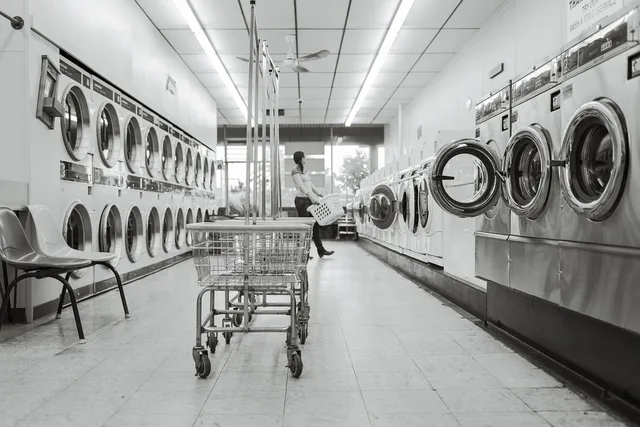
Three revenue streams share one room. Self-service customers rent machines by the cycle. Wash-dry-fold customers hand over a bag and pay by weight. Commercial accounts, if you take them, run on a pickup schedule.
Each stream has its own clock. Self-service peaks on weekends and evenings. Wash-dry-fold peaks when people are at work. Commercial accounts run on fixed routes.
The U.S. Bureau of Labor Statistics tracks this sector under Drycleaning and Laundry Services: Industry at a Glance. Use it for establishment and employment context. It will not tell you what your water rate is.
Roles on the floor
Four roles cover a typical store. Small stores combine them; the duties do not disappear when they do.
Four Laundromat Floor Roles
Attendant
- Main duty
- Walk room, restock, log faults
- Capacity
- 20-30 machines
- Key tool
- Log sheet, lint trap
- Does not do
- Repair machines
Wash-Dry-Fold Processor
- Main duty
- Sort, weigh, fold, stage orders
- Capacity
- 100-150 lb/hour
- Key tool
- Scale, folding table, two dryers
- Does not do
- Own maintenance
Maintenance Technician
- Main duty
- Service gas, electrical, sealed machines
- Capacity
- On-call, licensed trade
- Key tool
- Energy-control procedures, lockout hardware
- Does not do
- Attendant duties
Attendant. Opens the store and walks the room. Empties lint traps and wipes down folding tables. Restocks soap and change and handles customer questions. Logs every machine that stops mid-cycle. The attendant does not repair machines.
One attendant can cover 20 to 30 machines in a self-service room. Add a second attendant above 30 machines or when wash-dry-fold volume passes 150 pounds per hour.
Wash-dry-fold processor. Sorts incoming bags, weighs them, and tags them. Runs the order, folds to the customer's spec, and stages it for pickup. This role owns the order board and the promised ready time. One processor can handle 100 to 150 pounds per hour with a scale, a folding table, and two dryers dedicated to orders.
Maintenance technician. A licensed trade for anything involving gas, electrical, or a sealed machine. Per OSHA 1910.147, covered employers must have written energy-control procedures before anyone services equipment where unexpected startup or stored energy could injure them.
Name the machine brands on the service contract. Common brands include Speed Queen, Huebsch, Dexter Laundry, Continental Girbau, and Wascomat. Milnor, UniMac, and American Dryer Corp. are also common. Parts lead times differ by brand.
Owner or manager. Sets pricing, approves exceptions, reviews the numbers weekly, and holds the vendor and service contracts.
Write the escalation line once and post it. Attendant sees a fault, tags the machine out, logs it, calls the technician. No one improvises a repair.
The opening routine
The first thirty minutes set the day. Do them in the same order every time.
Opening Routine: First 30 Minutes
- Walk room with log sheet, note fault codes
- Check drain trough and floor drain for lint
- Test card or coin reader at one machine
- Confirm change machine, soap vendor, bill acceptor
- Empty lint traps, check dryer exhaust clear
- Match wash-dry-fold board to orders on shelf
- Walk the room with the log sheet. Note any machine showing a fault code or sitting with water in the drum. Check the drain trough and floor drain for lint clogs.
- Check the card or coin system reads correctly at one machine before customers arrive. Test a FasCard, WashCard, SpyderWash, or Nayax reader if that is your system.
- Confirm the change machine, soap vendor, and bill acceptor are stocked and working. American Changer and Rowe are common change-machine brands.
- Empty lint traps and check the dryer exhaust path is clear. A clogged exhaust adds drying time and raises gas use.
- Confirm the wash-dry-fold board matches the orders physically on the shelf.
Anything that fails gets tagged out of service and logged. A machine that runs badly costs more than a machine that is off.
Wash-dry-fold from drop-off to pickup
The order workflow is where most stores lose money quietly. Weight in, weight out, and a promise about time.
Wash-Dry-Fold Order Workflow
- Weigh bag at intake, record on ticket
- Sort by color and fabric before drum
- Run order in correct washer size
- Fold to customer's stated preference
- Stage finished orders by ready time
Weigh the bag at intake and record the weight on the ticket. The customer sees the number. Disputes at pickup almost always trace back to an unrecorded weight. Use a legal-for-trade scale, not a bathroom scale.
Sort by color and fabric before anything enters a drum. A red towel in a white load is a refund, not a redo. Keep separate nets for delicates and a bin for items that cannot go in a dryer.
Run the order, then fold to the customer's stated preference. Some want flat folds, some want hangers, some want it back in the bag. Standard wash-dry-fold uses a 30 to 40 pound washer for a 10 to 15 pound order. A 100 pound order takes three or four washer loads and three or four 50 pound dryer loads.
Stage finished orders by ready time, not by customer name. The processor pulls from the front of the queue and the promise holds.
Capacity math matters at intake. A 30 pound washer runs a wash cycle in about 25 to 30 minutes. A 50 pound dryer runs 30 to 40 minutes. If the store is open 12 hours, one washer can theoretically run 24 cycles. Plan on 12 to 18 cycles with loading, unloading, and cleaning time.
Pricing wash-dry-fold from the bottom up
Do not copy the store across town. Build the number from your own costs.
Cost per pound equals the sum of these divided by pounds processed in the period:
Pricing wash-dry-fold
- Water and sewer, from your utility bill
- Gas or electric for the dryers
- Chemicals and detergent, such as Ecolab, Diversey, or P&G Professional
- Processor labor hours times the wage
- Card-system fee on the transaction plus a share of rent, insurance, and machine depreciation
Typical U.S. Inputs, 2026
- $4-$12 | water and sewer per 1,000 gallons
- $0.80-$1.50 | gas per therm
- $0.10-$0.20 | electricity per kWh
- $12-$18 | processor labor per hour
Card fees often run 2 to 3 percent plus $0.10 to $0.25 per transaction. A self-service top-load wash typically sells for $3 to $6, a front-load wash for $6 to $12, and dryer time at $0.25 per 6 to 8 minutes.
Add your target margin to that figure. If the result is far above the local market, the gap is a signal to check your utility rate or your labor hours, not to guess.
Wash-dry-fold commonly prices at $1.50 to $2.50 per pound in many markets. A minimum order of 8 to 10 pounds covers the fixed cost of a small bag.
Set a minimum order weight. A two-pound order costs the same to process as a ten-pound order and pays a fraction of it.
Machine uptime and the maintenance queue
Uptime is the number that decides whether the store makes money this month. Track it per machine.
Log every fault with the machine number, the time, the fault code, and what the customer reported. A pattern across three washers on the same water line is a plumbing question, not three separate repairs. Speed Queen, Huebsch, and Dexter machines show fault codes on the control board; write the code on the tag.
Keep a parts shelf for the consumables your technician replaces most: belts, hoses, door seals, coin drops, card readers. A machine waiting on a part is a machine earning nothing. Order through a distributor such as PartsTown or your local dealer.
Set a service-call response target with your technician in writing. Ask what the realistic parts lead time is for your machine brands and hold the number. A 24 to 48 hour response target is common for metro areas; rural areas can run longer. Parts lead time often runs 3 to 10 days.
New versus used machines is a rebuild-cost question. Compare the purchase price plus expected service life against a rebuild of what you own. Ask the technician for the rebuild figure on your specific model.
New vs Used vs Rebuild
New
- 30 lb front-load cost
- $6,000-$12,000
- Service life
- Full expected life
- Parts lead time
- 3-10 days
Used
- 30 lb front-load cost
- $2,000-$5,000
- Service life
- Remaining life unknown
- Parts lead time
- 3-10 days
Rebuild
- 30 lb front-load cost
- $1,500-$3,000
- Service life
- Extended by rebuild
- Parts lead time
- Depends on drum, bearings, board
Cash, cards, and the money path
The card system is now the front door. When it goes down, the store stops selling. FasCard, WashCard, SpyderWash, and Nayax readers all need a backup plan for cash or coin.
Daily Money Reconciliation
- Reconcile card terminal against cycle count
- Reconcile coin drops against cycle count
- Investigate any gap same day
- Keep machine cycle count as independent check
- Retain records for purchases, sales, payroll, assets
Reconcile the card terminal and the coin drops daily against the machine-cycle count. A gap between cycles sold and money collected is either a fault or a theft, and both need an answer the same day.
Keep the machine cycle count as your independent check. It does not care what the payment system thinks happened.
For what records to keep, the IRS guidance on business records sets the standard. A system must clearly show income and expenses. Documents must support these items:
- purchases
- sales
- payroll
- assets Ask a CPA how long to hold each type for your situation.
Compliance you cannot delegate to memory
Four areas need a named owner and a paper trail.
Four Compliance Areas
- Energy controlwritten program, training, lockout hardware
- Gas and electricalNFPA 54 and NFPA 70, technician only
- Water and dischargeconfirm with municipal utility
- Licensing and insurancestate board and broker
Energy control. OSHA 1910.147 applies before any service where unexpected startup or stored energy could injure a worker. The written program, the training records, and the lockout hardware are the owner's responsibility, not the technician's.
Gas and electrical. NFPA 54 for gas, NFPA 70 for electrical. Your technician cites them. You do not work on either. NFPA 54 is the National Fuel Gas Code. NFPA 70 is the National Electrical Code.
Water and discharge. Local water authority and wastewater rules govern hookups and what leaves the building. Confirm with your municipal utility before any change. A typical commercial washer uses 2.5 to 4 gallons per pound of laundry, so a 30 pound load can use 75 to 120 gallons.
Licensing and insurance. State and municipal. Confirm with your state board and your insurance broker.
The SBA business guide lays out four stages. These are planning, launch, management, and growth. It also points to three resources. These are permits, insurance, and finance. Use it as a map, then confirm each item locally.
Common questions
Who owns the daily workflow in a laundromat?
The owner sets pricing and approves exceptions, but the attendant owns the floor and the wash-dry-fold processor owns the order board. Anything behind a panel or a gas valve belongs to a licensed technician. Write that line down and post it where staff can see it.
How often should I review the numbers?
Reconcile cash and card daily, review machine uptime weekly, and review pricing and labor monthly. Reopen the pricing decision whenever your water rate, gas rate, wage, or card fee changes. Those four inputs move the break-even more than anything else in the store.
Which numbers matter most?
Uptime per machine, pounds processed per labor hour, cost per pound, and the gap between cycles sold and money collected. Those four tell you whether the room is working, whether the back room is efficient, whether pricing holds, and whether the cash path is intact.
What should a new owner avoid?
Do not copy another store's price, service menu, or staffing ratio without knowing its utility rates and customer mix. Do not let an attendant attempt a repair to keep a machine running. And do not treat a machine that runs badly as a machine that is working.